One way to understand the evolution of AI is to look at what kind of structure it learns from the world.
The progression is not simply from smaller models to larger ones, or from less compute to more compute. It is a progression in representation: from detecting patterns, to organising knowledge, to modelling the world, to finding what remains reliable when the world changes, and finally to constructing the representation that best fits the problem at hand.
These levels are not clean historical stages. Modern AI systems often combine several of them. But they offer a useful way of seeing where increasing generality may come from.
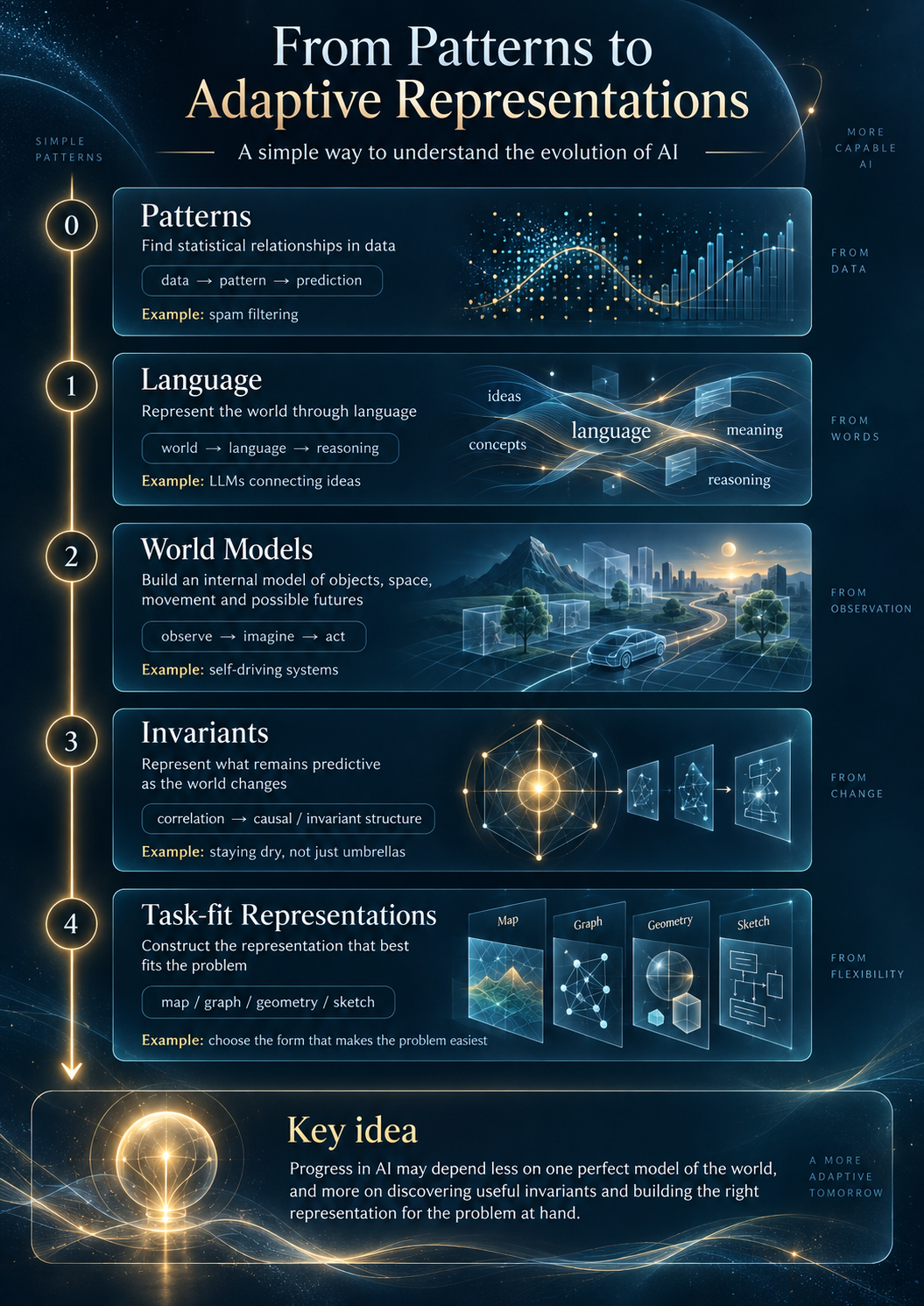
Stage 0 — Find patterns
Classical machine learning is very good at finding statistical relationships in data.
Give a system enough examples and it can learn that certain combinations of signals tend to predict a certain outcome:
data → pattern → prediction
A spam filter does not need a deep understanding of communication to recognise spam. A credit model does not necessarily need to understand the life of the person applying for a loan.
It can simply discover patterns that are predictive.
The weakness is obvious: a pattern that worked yesterday may stop working when the world changes.
Stage 1 — Represent the world through language
Large language models made a major leap by learning extremely rich relationships between concepts through language.
Words are not just labels. They carry enormous amounts of compressed human knowledge about objects, relationships, intentions, causes, emotions and abstract ideas.
This gives us something like:
world → language → conceptual reasoning
A language model can connect economics to psychology, biology to evolution, or philosophy to computer science because these relationships are reflected in human language.
But language is only one way of representing reality.
The world itself is not made of words.
Stage 2 — Build a model of the world
Some problems require representations that are closer to the structure of the world itself.
A self-driving car cannot rely only on the sentence:
“a cyclist is approaching from the right.”
It needs to represent position, velocity, objects, trajectories, uncertainty, possible futures and possible actions.
Similarly, world-model approaches try to learn internal representations that allow an AI to anticipate how situations may evolve.
The loop becomes something like:
observe → build an internal world → imagine possible futures → act
The goal is no longer only to detect patterns in observations, but to model the underlying dynamics that generated them.
Stage 3 — Represent what remains predictive as the world changes
A good world model is still not enough.
An AI can learn an extremely detailed representation of the world it has experienced and still fail when circumstances change.
The deeper challenge is to discover which features, relationships and mechanisms remain useful across different environments.
Consider a child learning about rain.
A shallow pattern might be:
rain → people carry umbrellas
A better representation might capture something deeper:
rain makes people wet → people use objects or clothing to stay dry
That relationship still works when the child encounters a different kind of umbrella, a raincoat, another country or an unfamiliar city.
The system has moved from learning correlations toward learning more invariant or causal structure.
The question changes from:
“What predicts what in the data I have seen?”
to:
“What is likely to remain predictive when the world changes?”
This is a crucial step toward robustness and generalisation.
Stage 4 — Construct the representation that fits the problem
But there may be an even more general capability.
Humans constantly change representations depending on the problem.
If we are planning a journey, we use a map.
If we are comparing expenses, we use a spreadsheet.
If we are thinking about an organisation, we may draw a network.
If we are moving furniture, a floor plan can suddenly make an apparently difficult problem easy.
The representation is part of the reasoning.
A sufficiently general AI may therefore not rely on one universal representation space.
Instead, it may need to ask:
“What way of representing this problem makes its structure easiest to understand?”
For one problem, the useful representation may be linguistic.
For another, spatial.
For another, geometric.
For another, a graph of relationships.
And for a completely unfamiliar problem, the system may need to construct a new representation altogether.
The progression then looks something like:
Patterns → Language → Worlds → Invariants → Representations on demand
The interesting shift is that intelligence starts to look less like building one increasingly detailed internal model of reality.
Instead, it looks like learning how to find useful abstractions.
A highly intelligent system may not need to represent everything about the world.
It needs to discover what matters, what remains predictive as circumstances change, and what representation makes the current problem easiest to understand and act upon.
In that sense, intelligence may be less about having the perfect model of the world, and more about continually constructing the right model for what comes next.