
What Cybernetics Might Reveal About Apple’s AI Strategy
A cybernetic reading of cloud and edge AI: which decisions belong locally, and which need coordination?
Read the essayStart here · A guided introduction
What connects a cell finding its way, a person learning something new and a company deciding what to build? Start with a perspective, then explore it through an essay, an experiment and a story.
01 · Understand the perspective
I explore intelligence as the capacity to learn, adapt and act in a changing world, from cells and individuals to teams, companies and societies.
Inspired by Active Inference, I use a recurring loop:
Observe → Imagine → Evaluate → Act → Become
We notice what is happening, imagine possibilities, evaluate what matters and act. The consequences can change both our surroundings and our understanding. That is what I mean by Become: the next loop starts from a different place.
Pragmatic value: moving toward an outcome that matters.
Epistemic value: gaining information that reduces uncertainty.
The same action can do both. Across scales, one system’s actions also change the conditions that others learn and act within.
This perspective invites a practical question: how can the parts of a system become more capable together? Coordination can help, but it can also suppress useful differences. More connections alone do not guarantee better collective decisions.
Active Inference, developed by Karl Friston and colleagues, offers a formal approach to perception, learning and action. Models of future action can bring together preferred outcomes and expected information gain.
The Free Energy Principle offers a theoretical account of how systems can persist through their exchanges with an environment. Under its assumptions, these dynamics can be described through the minimization of variational free energy. This is broader than simply correcting a prediction error.
A Markov blanket describes a statistical boundary: internal and external states are conditionally independent given the blanket states. In Active Inference models, sensory and active states mediate their interaction. A cell membrane or an organization chart is not, by itself, sufficient to establish such a boundary.
I use multi-scale Active Inference as a lens for exploring connections across systems. Applying it to a team, company or society requires specifying the model and testing its assumptions. My five-stage loop is a teaching synthesis inspired by this work, rather than a formal five-step definition of the theory.
Read the research: Active inference and epistemic value ↗The Markov blankets of life ↗
02 · Follow a question
Explore the tension between local autonomy and shared coordination. This essay uses Apple’s AI strategy as a starting point for a wider question about how intelligence is organized.
A cybernetic reading of cloud and edge AI: which decisions belong locally, and which need coordination?
Read the essay03 · Try it for yourself
In Two Gates, compare possible actions in an uncertain world. Try a route that gathers information before pursuing the goal, and examine what that information changes.
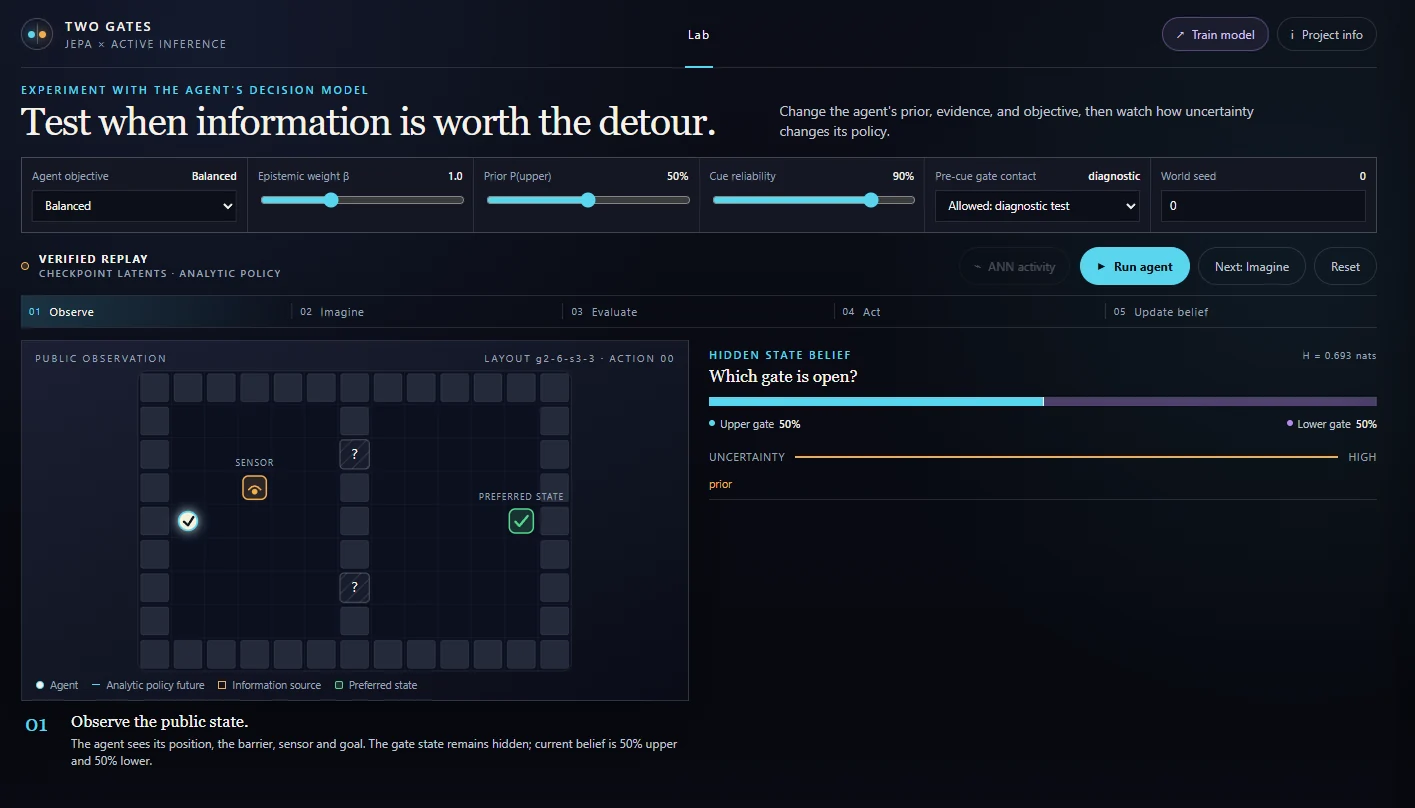
Explore when information is worth a detour. Compare imagined futures, uncertainty and action in a small decision environment.
Explore the experiment04 · Experience a possible world
Dö för Dig brings AI, responsibility and the limits of control into a story about the people we love. A Swedish novel that lets you experience these questions from the inside.
Discover Dö för DigFrom perspective to practice
If you are exploring AI, a product opportunity or a new venture, we can work through what matters and what to try next.
Explore ways to work with me ↗Browse all essays ↗