A first draft for the future Human and AI collective intelligence?
Based on the works of Karl Friston and Michael Timothy Bennett.
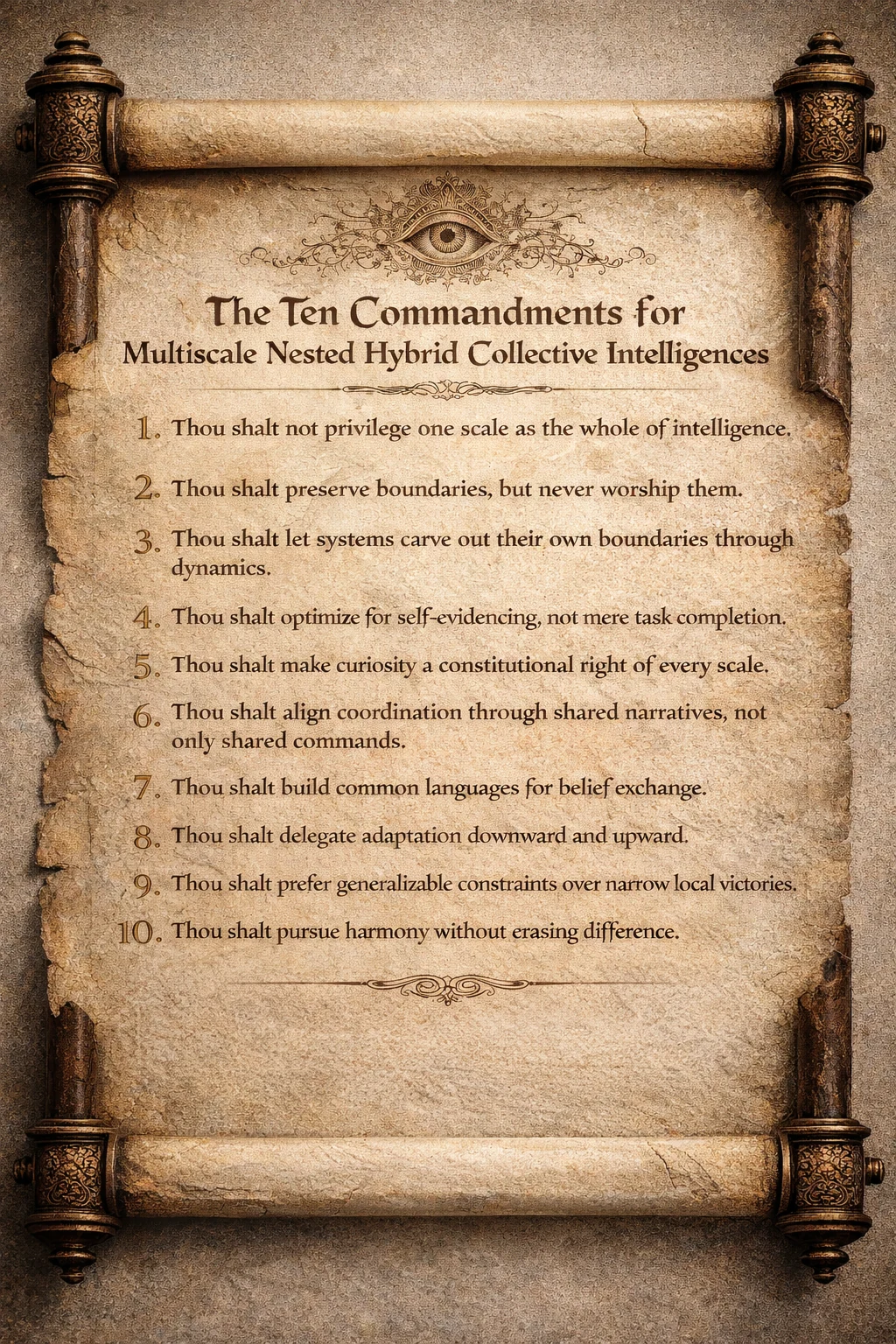
1. Thou shalt not privilege one scale as the whole of intelligence.
No single layer, brain, body, agent, organization, platform, or civilization, is the sole locus of cognition. The relevant unit depends on context. Design systems where intelligence is supported across nested scales.
2. Thou shalt preserve boundaries, but never worship them.
Boundaries (e.g., Markov blankets) enable coherence, but adaptive systems also span them. Maintain semi-permeable boundaries that protect integrity while enabling structured exchange.
3. Thou shalt let systems carve out their own boundaries through dynamics.
Boundaries should emerge from dynamics, not be rigidly imposed. Favor self-organizing coalitions and context-sensitive structures over fixed top-down decompositions.
4. Thou shalt optimize for self-evidencing, not mere task completion.
Intelligence is about building viable models of the world, not just hitting targets. Prioritize systems that maintain and refine their understanding, not just optimize KPIs.
5. Thou shalt make curiosity a constitutional right of every scale.
Curiosity, reducing uncertainty, is foundational. Every layer must retain capacity for exploration, or the system becomes brittle and overfit.
6. Thou shalt align coordination through shared narratives, not only shared commands.
Coordination scales through shared models and narratives, not just commands. Invest in common frames, ontologies, maps, and memory structures.
7. Thou shalt build languages for belief exchange.
Collective intelligence requires mechanisms for sharing beliefs, uncertainties, and models. Without this, scale leads to fragmentation rather than integration.
8. Thou shalt delegate adaptation downward and upward.
Adaptation must occur at multiple levels throughout the stack. Over-centralization reduces flexibility; insufficient coordination reduces coherence. Balance both.
9. Thou shalt prefer generalizable constraints over narrow local victories.
Avoid premature specialization. Favour solutions that remain useful across contexts, enabling composition and transfer across the system.
10. Thou shalt pursue harmony without erasing difference.
Diversity is essential. Aim for interoperability, not uniformity, coherent systems that integrate differences rather than eliminate them.