
Collective intelligence (CI) is intelligence that emerges from the collaboration, collective efforts and competition of many individuals. Research has shown that CI functions best under certain conditions: inclusivity, shared goals, and trust. For a democratic society, these aspects are vital to fostering resilience and coherence, especially in times of deepening societal polarization, as highlighted by the World Economic Forum’s Global Risks Report 2024. World Economic Forum · Global Risks Report 2024
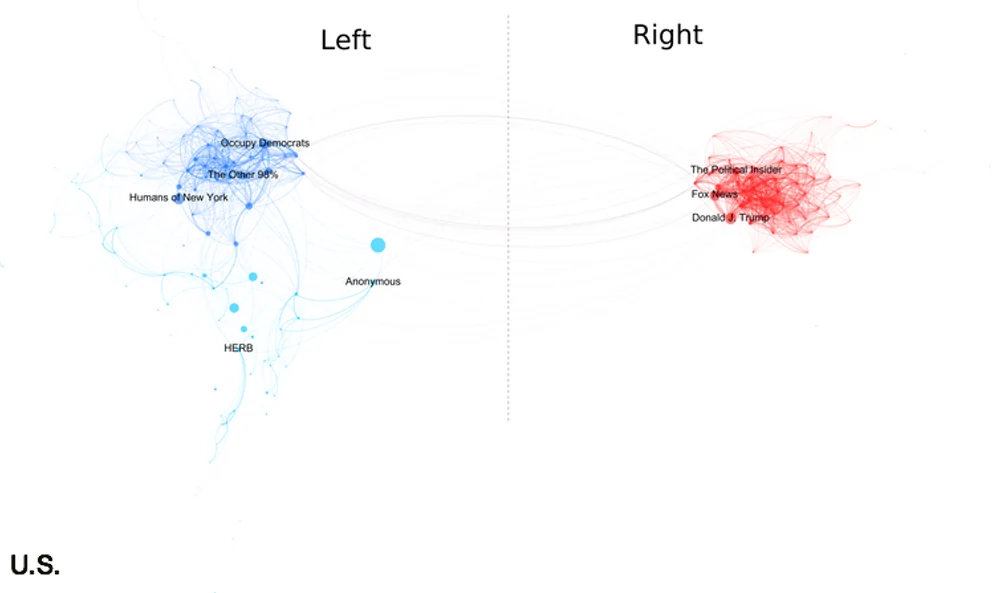
The above graph, from a study on the online behavior of Facebook users in the United States, illustrates the political echo chambers in user interactions. Blue lines represent Democrats, while red lines represent Republicans. The concentration of blue on the left and red on the right highlights how users predominantly engage with content that aligns with their political views. The minimal connecting lines between the two groups indicate a limited shared interest in exploring perspectives from the opposite side.
In a democratic country, CI plays a key role at multiple levels: citizens, communities, organizations, and governmental bodies all contribute distinct insights to tackle shared challenges. Each level must collaborate seamlessly to make sense of and respond to complex issues, from environmental crises to economic challenges. The effectiveness of collective intelligence depends on several factors: diverse perspectives, transparent information flow, and active engagement among citizens and institutions.
However, achieving this ideal in a democracy where polarization is growing poses significant challenges. The 2024 Global Risks Report emphasizes that societal polarization has intensified, now ranking among the most urgent global risks. Misinformation and disinformation are crucial accelerators of this divide, undermining trust in institutions and facts alike. These divisions disrupt the emergence of CI by fragmenting public discourse and eroding a shared sense of reality, making it difficult to respond effectively to crises or engage in long-term planning.
When collective intelligence degrades, the consequences extend beyond disagreement or political inefficiency. A democracy that cannot sustain collective intelligence will increasingly rely on coercion, spectacle, and force, not because it wants to, but because it has lost the ability to coordinate meaningfully. In such conditions, democratic decision-making becomes brittle, reactive, and prone to escalation rather than adaptation.
For collective intelligence to work effectively, democracies must address these polarizing forces. This involves ensuring reliable access to verified information, encouraging inclusive participation, and fostering open dialogue. CI is essential for facing the complexities of a rapidly transforming world. Without collective intelligence, democratic forms persist while democratic function collapses. Without it, we do not have a functioning democracy.