As our systems become more connected, something counterintuitive happens: gaining control often becomes harder, not easier.
Cybernetics noticed this long before the digital age. In the 1950s, W. Ross Ashby formulated The Law of Requisite Variety: Only variety can absorb variety. In simple terms, a system trying to regulate another system must have at least as much variety in its possible responses as the disturbances it faces.
And this is where modern technological systems run into an interesting tension. We connect more and more parts of the world in order to optimize and control things locally: organizations, supply chains, information networks, financial systems, and increasingly AI-driven processes. But every new connection increases the number of interactions in the larger system. More dependencies, more feedback loops, more non-linear dynamics. The global system becomes richer in possibilities, and therefore harder for any single control center to fully regulate.
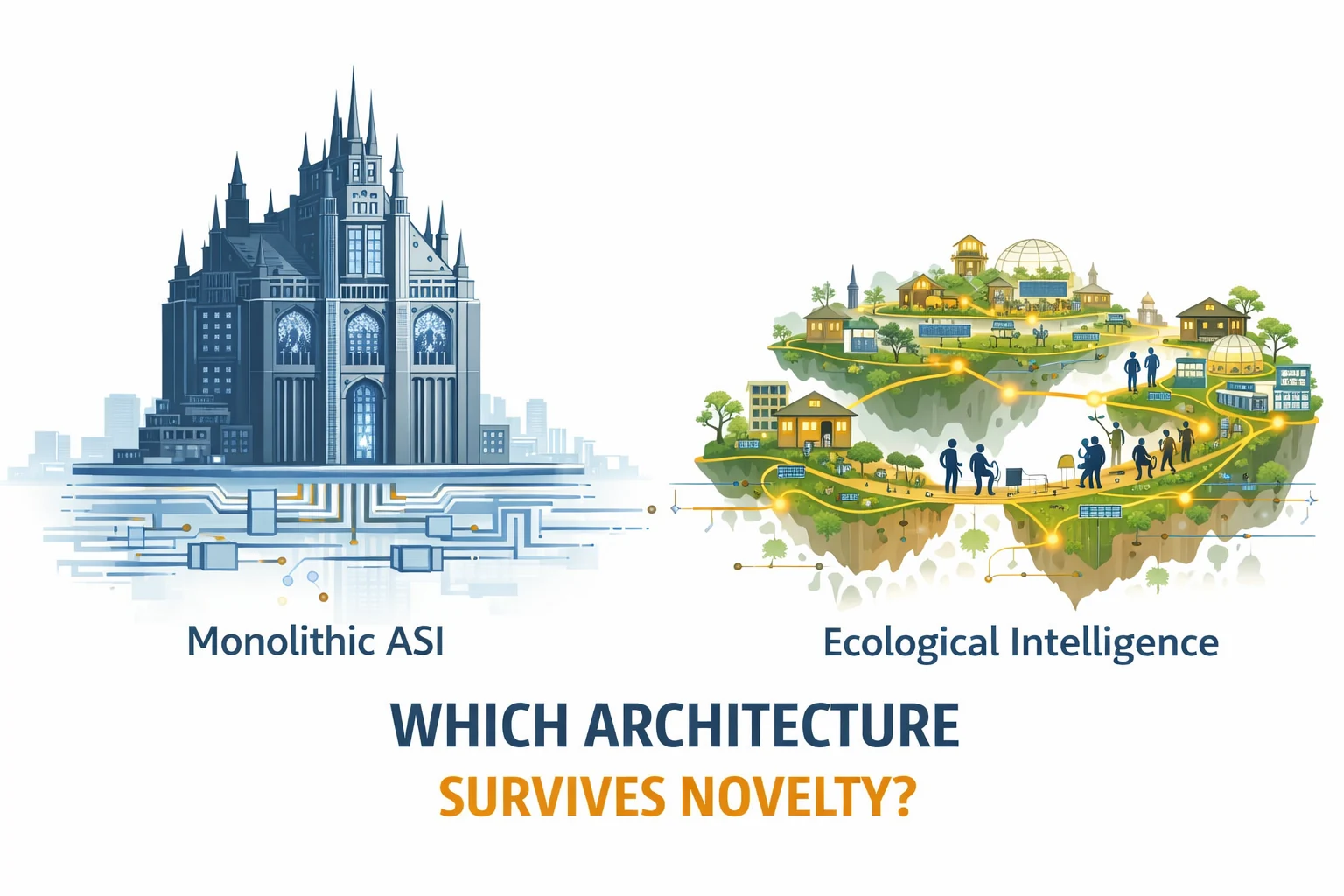
Nature offers a useful perspective here. Biological systems rarely rely on purely centralized control. The human body combines central coordination (the brain) with massively distributed regulation (immune system, hormones, local cellular processes). Political systems often follow a similar pattern. Effective governance rarely means that everything is decided at the top. Instead, many stable systems rely on the subsidiarity principle: decisions should be taken at the lowest level capable of handling them, while higher levels coordinate when necessary.
In other words, stability often emerges from hierarchies of distributed regulators, not from a single center of control.
What makes the current moment particularly interesting is that we are no longer only talking about technical systems. The emerging system includes multiple forms of intelligence interacting at once:
- individual human intelligence
- collective human intelligence (teams, organizations, institutions, markets)
- artificial intelligence systems
- distributed digital infrastructures connecting them
Together they form something closer to a hybrid ecosystem of intelligences.
In systems like these, structure alone is not enough. What matters just as much is how information flows through the system. Stable complex systems rely on information moving in multiple directions:
- bottom-up, where local realities and signals propagate upward
- top-down, where coordination and goals propagate downward
- horizontally, where actors at the same level share information and learn from each other
Democratic systems work this way. Biological systems work this way. Healthy organizations work this way. Without bottom-up information, central coordination becomes blind. Without top-down guidance, local actors lose coherence. Without horizontal exchange, learning slows and fragmentation grows.
This perspective makes the current evolution of AI architectures particularly interesting. Much of the AI industry is concentrating intelligence in increasingly powerful centralized models running in large cloud infrastructures. At the same time, companies like Apple are investing heavily in local AI capabilities on every device, enabled by Apple Silicon and dedicated neural engines.
From a cybernetics perspective, this may not simply be a technical choice. It may reflect a deeper architectural pattern. Complex systems tend to stabilize through layered intelligence across scales:
- local intelligence handling local variation
- higher-level intelligence coordinating larger patterns
Cloud models may provide large-scale reasoning and coordination. Edge devices may handle perception, interaction, and context. Humans and institutions remain part of the regulatory system. Together they form something closer to a multi-scale ecosystem of human and artificial intelligences, where information flows upward, downward, and across the network.
If cybernetics teaches us anything, it is that complex systems rarely remain stable through pure centralization or pure decentralization. They tend to evolve toward hierarchical systems where intelligence exists at multiple levels, each absorbing the variety it is best positioned to handle.
The real question for the AI era may therefore not be cloud vs edge. It may be how well we design the subsidiarity of intelligence and the flow of information between humans, institutions, devices, and global AI systems.